In a time when politicians and leaders are set on sowing hatred bent on tearing us apart, O’Neill’s latest single offers to bind us.
T.E: On my third listen of this song in 24 hours, I feel the warmth in my cheeks reaching upwards towards my eyelids as I am transported back to Larmer Tree Gardens – by this point in Lisa’s set my tears could scarcely remember their home and each new verse prompted a deluge afresh. Lisa narrates with wist and bitter disdain the problems we collectively face.
We know from All of This is Chance that O’Neill has mastered ethereal dreamscapes. Her perspective casts a clay cuboid, which is fired and kiln-dried to an artefact embodying both everything and nothing that we have ever seen. She clearly draws from canonic folk, but her output comes doused in personality and her uniquely enchanting vocal.
M.J: Behind it all is the constant drone, weaving itself in and out of the free-reed aerophone instrument (unknown accordion adjacent), a bed of leaves to soften footsteps. The drone is becoming an iconic feature of the folk scene with it appearing on records and in sessions around the country. The pipes have traditionally always filled this role, Seb Stone is a Sheffield based musician who gigs sessions and solo with traditional irish uilleann pipes.
Eoin Murray of Anois, Os Ard in his insightful article on the current form of drone in Irish folk:
“Nowadays, it’s felt in the feverish thrum of DIY shows and trad sessions alike; in the nasal timbre of unaccompanied sean-nós singing and the natural buzz of field recordings; in the booming bells and organs of churches, and the electric groan of digital synths.”
With home-made pedal operated shruti boxes, Jacken Elswyth accompanies herself on the banjo, adding an incredibly tangible layer of significance to the music and storytelling. In this way, O’Neill affirms the importance of her storytelling: you can hear it in her delicate performance of Old Note at the late Manchán Magan’s funeral. Ian Lynch of Lankum proffers a cosmic explanation for the effect these vibrations have on listeners and performers alike:
“all life in the universe stemmed from this great eternal drone, and how the unity that we all seek is to be a part of this vibration”.
T.E: I think fundamentally, Lisa O’Neill’s sense of time is unparalleled. On the Garden Stage at End of The Road, she introduced Old Note by telling the crowd that the sample is her nephew, who innocently laments “they’re sad; they’re sad because the song is over”
In her new track, O’Neill narrates:
Oh, to be wild like the roses. Oh, to be red with delight.
My blood is red out of fury, the wind doesn’t blow this far right.
I feel the red-blood fury which she describes, I feel it over and over again – virtually every time I brush sides with the mainstream media. She speaks to a kindness which reaches our core, and an incompatible anger which negates human kindness. I felt the anger the weekend before last in St Thomas’ Hospital, watching a 30-minute newsreel repeat over the course of 5 hours, how stories were spun and presented with more regard to agenda than to facts, spinning a surely obvious genocide-apologist, counter-fairness narrative.
M.J: O’Neill presents a question: what is it that defines us? The blood is the Body Politic: the state institutions around us in the form of a visceral body with lungs, beating heart and red blood. But for what reason is the blood red? Red like the roses, wild, connected to nature and free? No - that is an ideal. The blood is red with fury. We are presented with an assault on humanity’s connection with nature. This hatred, which she does not shy away from naming as far right, is pulling her away from the earth; we are being divided from each other and from all beings around us. This genocide is humanity at its most removed from the natural order.
Drill baby, drill.
Don’t baby don’t.
Kill baby, kill.
don’t baby don’t.
Beautiful planet,
Beautiful children, starved to their bones.
T.E: The sincerity with which she narrates, the red thread of humanity which needles its way through her stories provides that slender wind of hope. I feel lucky to be alive at the same time as Lisa O’Neill, and when I hear her sing of division, I can also sense millions of voices sharing her feelings of love, acceptance and community.
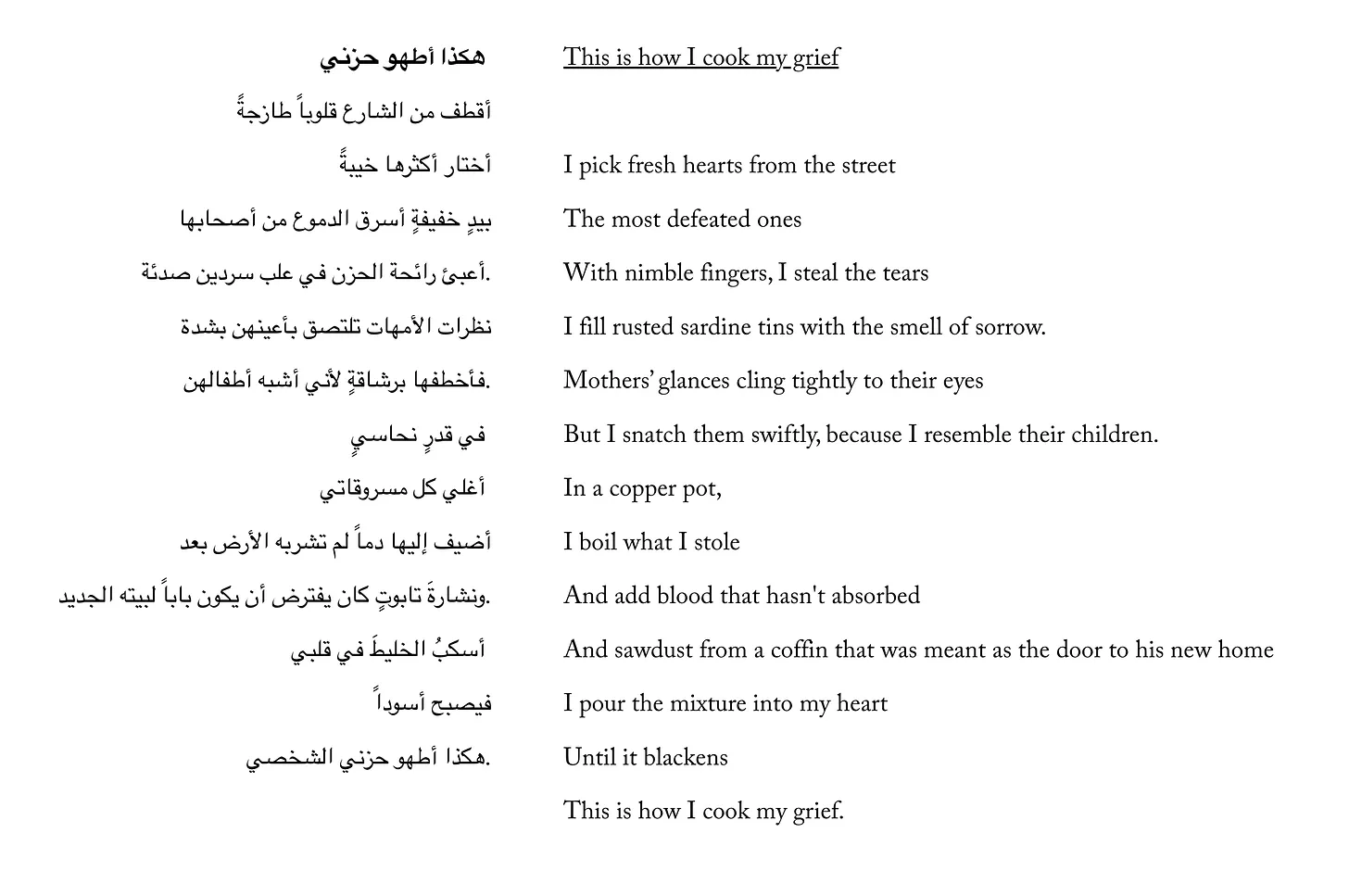
As an adjunct to this track, we thought it important to bring a more direct perspective on the atrocities being committed in Gaza. This poem by Palestinian poet Batool Abu Akleen offers a sensory reaction of grief and brings us into the world of hunger, pain and sorrow.